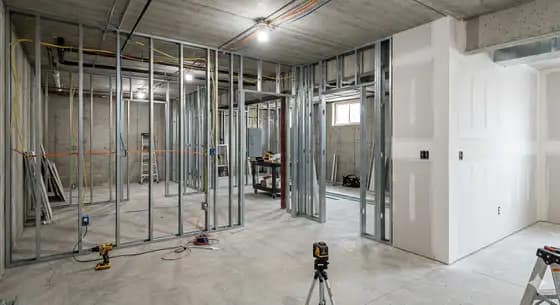
Finishing a basement in Delaware costs between $10,000 and $75,000 for most residential projects in 2026. The wide range reflects the difference between a basic open-plan space with standard materials and a full fit-out with a bathroom, bedroom, and separate entrance. According to Delaware contractor Carl Deputy and Son Builders, who serve Kent and Sussex Counties, project costs depend primarily on the current state of the basement, the scope of work, and the finishes selected.
On a per-square-foot basis, expect to pay $25 to $75 per square foot for finished Delaware basement space, with the average mid-range project running $32,000 to $40,000. National data from HomeAdvisor and Angi puts the national average at $32,000, and Delaware projects track closely to that figure given the state’s construction costs running 8 percent above the national average.
A finished basement delivers a return on investment of 64 to 70 percent at resale, according to national cost-value reports. Beyond resale, the immediate benefit is usable living space at a cost per square foot significantly lower than building an addition above grade.
Delaware Basement Finishing Cost by Project Scope
| Scope level | What is included | Typical cost (Delaware) |
|---|---|---|
| Basic open plan | Framing, insulation, drywall, flooring, lighting, one electrical circuit | $10,000–$20,000 |
| Mid-range finish | Above plus bedroom, egress window, upgraded flooring, paint, additional circuits | $20,000–$45,000 |
| Full fit-out | Above plus bathroom, kitchenette, custom storage, premium finishes | $45,000–$75,000+ |
| Luxury suite | Separate entrance, full kitchen, full bathroom, custom millwork, premium materials | $75,000–$150,000+ |
These figures assume a dry, structurally sound basement with reasonable ceiling height. Basements with moisture problems, low headroom, or significant structural work needed will cost more before any finishing begins.
Cost by Basement Size
| Basement size | Basic finish | Mid-range finish | Full fit-out |
|---|---|---|---|
| 400–600 sq ft | $10,000–$18,000 | $18,000–$30,000 | $30,000–$50,000 |
| 700–900 sq ft | $14,000–$24,000 | $24,000–$40,000 | $40,000–$65,000 |
| 1,000–1,200 sq ft | $18,000–$32,000 | $32,000–$55,000 | $55,000–$85,000 |
| Over 1,200 sq ft | $22,000–$40,000+ | $40,000–$70,000+ | $70,000–$125,000+ |
Individual Component Costs
Understanding what each component costs helps you prioritise scope and understand what your contractor’s quote includes or excludes.
| Component | Cost estimate |
|---|---|
| Framing (wood stud) | $18–$24 per linear foot installed |
| Insulation (batt or rigid foam) | $1–$3 per square foot of surface area |
| Drywall (installed) | $2.00–$4.00 per square foot |
| Flooring (LVP) | $3–$8 per square foot installed |
| Flooring (carpet) | $3–$7 per square foot installed |
| Flooring (tile) | $6–$15 per square foot installed |
| La pintura de interiores | $1–$3 per square foot |
| Drop ceiling | $4–$20 per square foot |
| Drywall ceiling | $2–$4 per square foot installed |
| Electrical (rough-in and fixtures) | $4–$9 per square foot of basement floor area |
| Plumbing rough-in | $4–$6 per square foot, or $450–$1,800 per fixture |
| HVAC extension | $1,800–$3,100 for ductwork; $25–$55 per linear foot |
| Egress window installation | $2,500–$5,000 installed |
| Bathroom addition (full) | $10,000–$25,000 |
| Bathroom addition (half) | $5,000–$12,000 |
| Waterproofing (if needed) | $3,000–$10,000 |
| Permits and inspections | $500–$2,000 |
Delaware-Specific Considerations for Basement Finishing
Moisture and waterproofing
Delaware’s Mid-Atlantic climate brings significant rainfall and high groundwater levels in many areas, particularly in low-lying parts of New Castle County and coastal Sussex County. Basements in Delaware that show any sign of moisture intrusion, including staining, efflorescence on block walls, or a musty smell, must be waterproofed before any finishing work begins. Bromwell Construction, a Delaware contractor, notes that finishing a basement with unresolved moisture problems will result in mould, damage to finishes, and a project that needs to be redone within a few years.
Waterproofing solutions range from exterior drainage systems and foundation coating, which typically cost $8,000 to $20,000, to interior drain tiles and sump pump systems at $3,000 to $8,000. Interior systems manage water that enters the basement rather than preventing entry, and they are the more common solution for existing Delaware homes.
Ceiling height requirements
Delaware follows the International Residential Code, and Sussex County has adopted the 2021 IRC. For a basement room to count as habitable space, the ceiling must be at least 7 feet high under beams and ductwork. Many older Delaware homes have basement ceiling heights of 7 to 7.5 feet, which leaves limited clearance once framing and ceiling materials are installed. Your contractor should measure ceiling height before finalising scope, and flag any areas where headroom will be tight after construction.
Egress requirements
Any basement bedroom in Delaware must have an egress window or door that provides a safe emergency exit. The IRC requires a minimum net clear opening of 5.7 square feet, a minimum height of 24 inches, and a minimum width of 20 inches. Installing an egress window in an existing basement typically requires cutting through the foundation wall and adding a window well, which costs $2,500 to $5,000 per window including excavation and drainage.
Permit requirements in Delaware
Basement finishing almost always requires a building permit in Delaware. Projects that add habitable square footage, include electrical or plumbing work, or create new rooms all trigger the permit requirement. Both Kent County and Sussex County require permits for all construction activity including finishing and remodelling. New Castle County and incorporated cities like Wilmington, Newark, and Dover each manage their own permitting processes.
Permit fees for basement finishing typically run $500 to $2,000 depending on project scope and jurisdiction. Your contractor should pull the permit before work begins. A contractor who suggests skipping permits to save money is a contractor to avoid: unpermitted work creates problems at sale, can result in code violation fines, and may not be covered by your homeowner’s insurance.
Older Delaware homes
Delaware has a significant stock of older housing, particularly in Wilmington and the older suburbs of New Castle County. Homes built before 1980 may have lead paint on existing basement surfaces, asbestos-containing materials in pipe insulation or floor tiles, and older electrical panels that need upgrading before a basement can be finished safely. Budget for a pre-construction assessment if your home is pre-1980.
How Long Does Basement Finishing Take?
A standard basement finishing project in Delaware takes four to eight weeks from permit approval to completion. Projects that include bathroom additions, significant plumbing work, or custom elements typically run ten to sixteen weeks. Timeline is heavily influenced by permit approval speed, which varies by municipality.
New Castle County and the City of Wilmington tend to have more complex permitting processes and longer review times than Kent or Sussex County. If timeline matters to your project, ask your contractor for a realistic permit timeline before starting.
How to Evaluate Basement Finishing Quotes
Basement finishing quotes vary widely because the scope of work can be defined differently by different contractors. When comparing quotes, confirm that each one addresses the same list of items:
- Permit fees included or excluded
- Framing specification (wood stud, metal stud, width)
- Insulation type and R-value
- Drywall type (standard, moisture-resistant, fire-rated)
- Drywall finish level
- Flooring type and area covered
- Electrical scope (number of circuits, outlets, lighting fixtures)
- Plumbing scope if applicable
- Who coordinates subcontractors (plumber, electrician, HVAC)
- Clean-up and disposal
A quote that omits electrical, plumbing, or permits is not necessarily dishonest. The contractor may be providing a price for their own scope only. Make sure you understand the full cost before comparing totals.
Basement Finishing ROI in Delaware
A finished basement adds functional square footage at a fraction of the cost of an above-grade addition. In Delaware’s residential market, finished basement space is valued at 50 to 70 percent of the cost per square foot of above-grade living space. On a project costing $35,000, a 65 percent ROI represents $22,750 in added home value at resale.
The financial case is strongest when the basement is used as a rentable unit. Delaware’s rental market, particularly in New Castle County near Wilmington and the University of Delaware campus in Newark, supports strong demand for legal basement apartments with separate entrances. A properly permitted and code-compliant basement apartment can generate $1,000 to $1,500 per month in rental income in New Castle County.
Preguntas Frecuentes
Does finishing a basement require a permit in Delaware?
In most cases, yes. Any work that adds habitable square footage, creates new rooms, or involves electrical, plumbing, or HVAC changes requires a permit in Delaware. The specific requirements vary by county and municipality. Your contractor should advise on permit requirements for your specific project and jurisdiction before work begins.
How do I know if my basement is dry enough to finish?
A simple test: tape a piece of plastic sheeting to the concrete floor and walls, seal all four edges with duct tape, and leave it for 48 to 72 hours. If condensation forms on the underside of the plastic (between plastic and concrete), water is moving through the slab. If condensation forms on top, the basement is humid but the concrete is dry. Any signs of active moisture need to be resolved before finishing begins.
Can I finish a basement with low ceilings?
If ceiling height after framing and drywall would fall below 7 feet, the space cannot legally be classified as habitable. Options include lowering the floor slab (expensive, $15,000 to $40,000), using thin materials like metal stud framing and low-profile ceiling systems, or accepting that the space will be used for storage and mechanical access rather than living space.
How do I add a bathroom to my basement?
Adding a bathroom in a basement where plumbing rough-ins already exist is significantly cheaper than adding one from scratch. If your basement has an existing rough-in, a full bathroom addition runs $10,000 to $18,000. Without rough-ins, the plumber must break through the concrete floor to run new drain lines, which adds $3,000 to $6,000 to the plumbing scope. A macerating toilet system avoids cutting the floor but is not accepted by all inspectors for code compliance.
Start Your Delaware Basement Finishing Project
Delaware Drywalls connects homeowners with one verified, licensed basement finishing contractor for their project. We verify licences, confirm insurance, and introduce you to a single contractor who is active in your county and experienced with Delaware’s permit requirements.
Presentar su proyecto libre de solicitud and we will respond within 24 hours.
 English
 Español de México